Healthcare
Enterprise Product
Under NDA
Role
Senior Product Designer
Disciplines
Product Design, UX, UI, Research and Design Systems
Client
Orthopaedic hospital group
Platform
Web, Tablet & Mobile

01
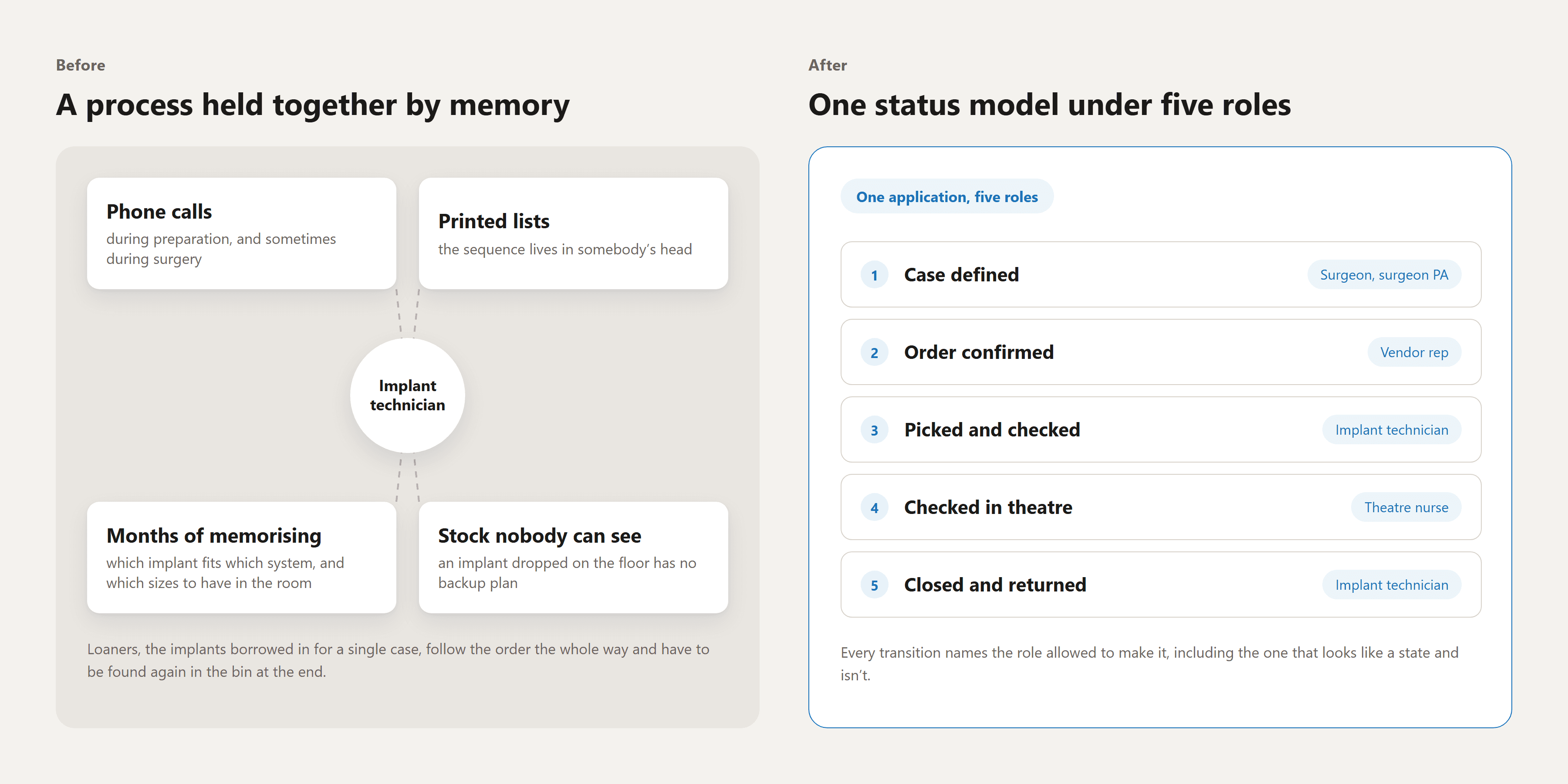
An orthopaedic hospital was running its implant supply chain without software. Cases were scheduled in the hospital’s record system; everything after that was phone calls, printed lists and technicians who had learned the catalogue by heart.
I designed the system that replaced it. One application, five roles, one status model underneath all of them, carrying a case from scheduling through vendor confirmation, picking, quality checking, transfer to theatre, the last check before anything is opened, and closing out afterwards.
I was the only designer on the engagement. The engagement manager and I ran the interviews and the stakeholder sessions together.
02
There was nothing to improve. No product to redesign, no competitor solving the same problem, no screens to argue with. When we asked when the problem had started, the answer was that the process had always been manual.
A manual process that works is held together by people who remember things. Training a technician meant months of memorising which implant fits which system, which brands the hospital stocks, and which sizes have to be in the room in case the first choice doesn’t fit. The cost arrived as phone calls: a surgeon’s team ringing the technician room during preparation, and sometimes during surgery.
Two things made it worse, and he wrote both down himself at the time: an implant dropped on the floor has no backup plan, because the stock a technician can reach is not on any screen; and loaners, the implants borrowed in for a single case, take a long time to handle. The loaner follows the order the whole way, and it has to be found again in the bin at the end.
This ends in an operating theatre, with gloved hands, a sterile field and a patient on the table, where an implant that doesn’t fit costs a second operation.
03
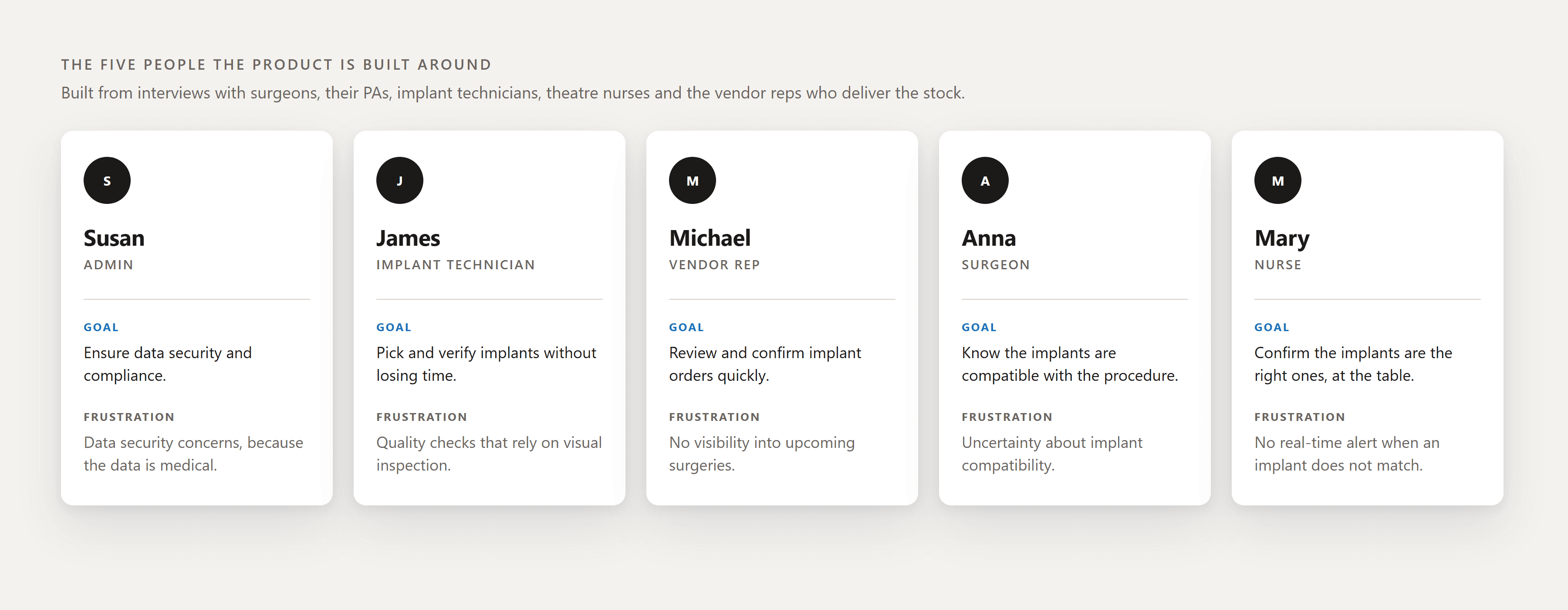
We interviewed the people who would use it: surgeons and their PAs, implant technicians, theatre nurses, the vendor reps who deliver the stock, and the supply chain administrators. Five personas came out of those conversations: the administrator, the implant technician, the vendor rep, the surgeon and the nurse. They are the five roles the product is built around.
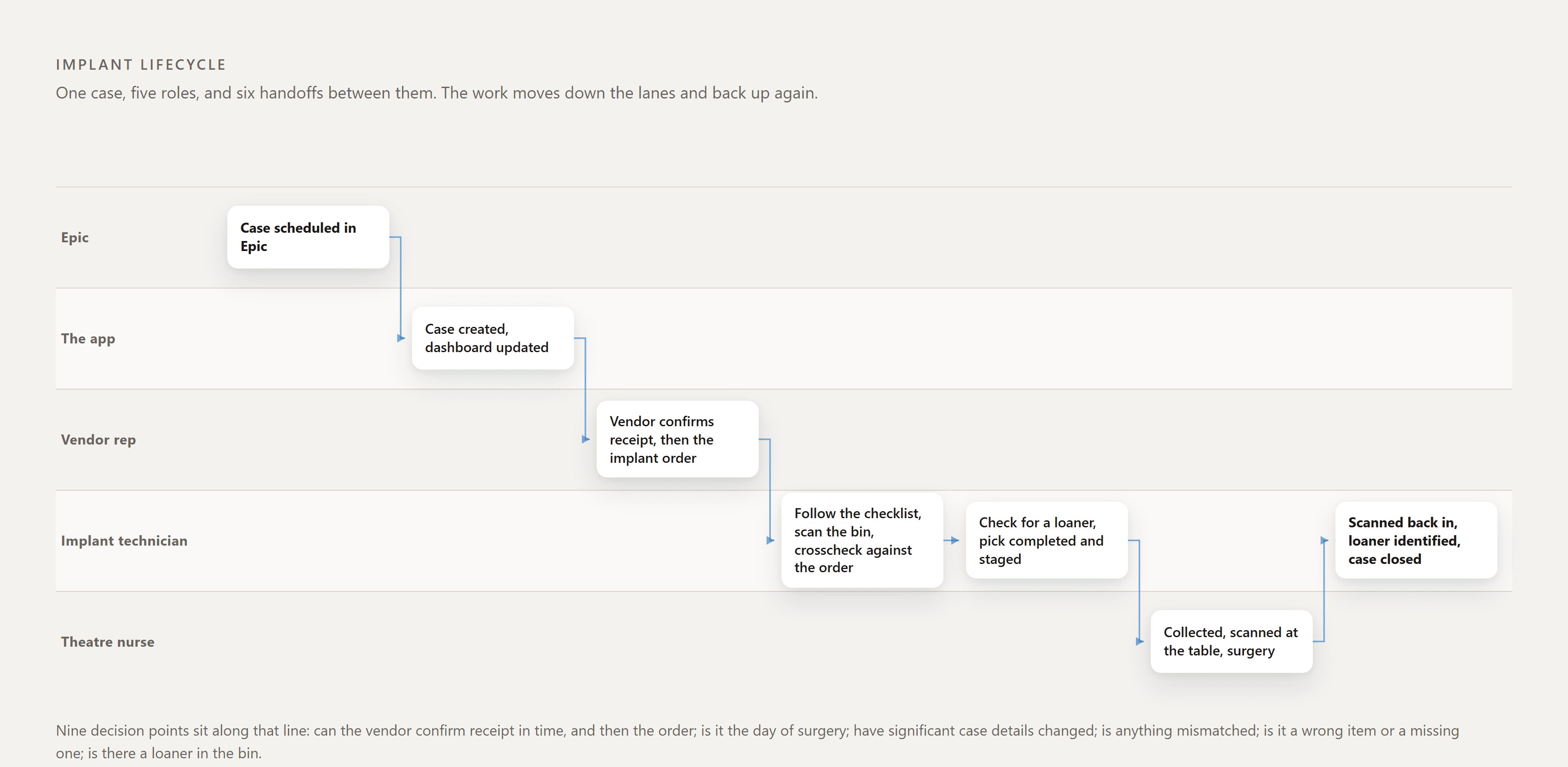
I drew the process as it ran, then as it would have to run, in three phases. The as-is diagram did most of the arguing: it showed how much of the sequence lived in somebody’s head.
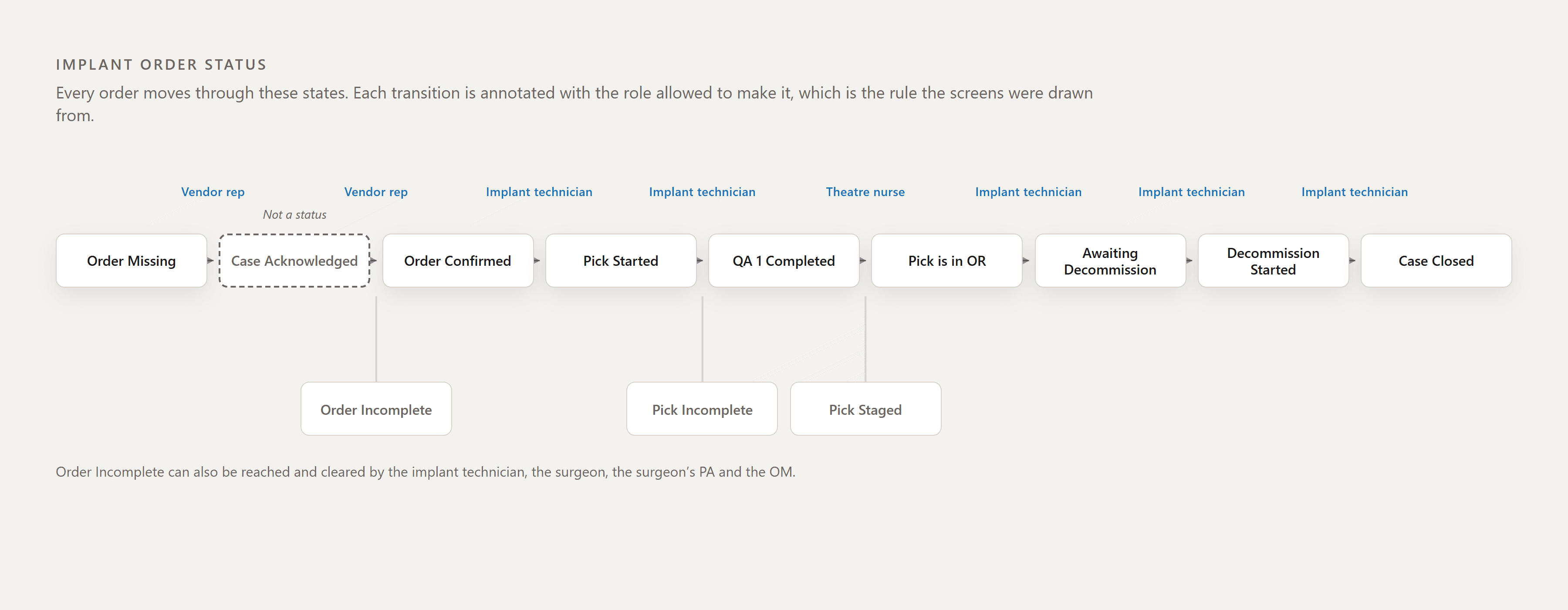
Then the status model. Every implant order moves through a set of states, and I wrote down which role is allowed to make each transition, including the one that looks like a state and isn’t. The screens were drawn from that.
04
The Tension
What I chose
What it cost

The Tension
What I chose
What it cost

The Tension
What I chose
What it cost

05
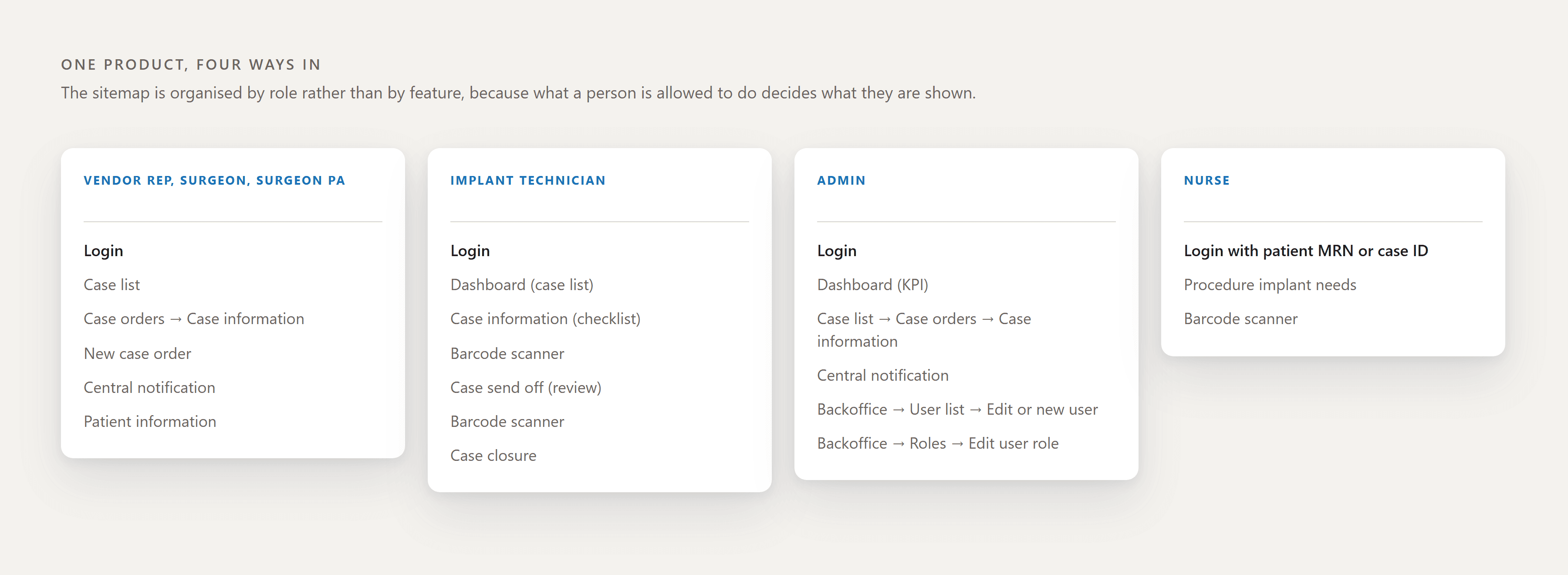
A case arrives from scheduling and becomes a request with everything attached to it: the system, the compatible implants, the brands, and the sizes to have in the room.
The technician works a queue instead of a phone. Picking is scanned rather than ticked, and the items still outstanding stay visible while the work is happening.
Quality checking is a stage with its own owner. The handoff between the two people who do it happens on screen.
In theatre the implant is scanned and checked against the case on a screen on the wall, item by item, before anything is opened. Surgeons and nurses both read it, and neither has to touch it.
Vendor reps confirm orders from a phone, which is where they are.
06
HOW IT WAS REVIEWED
WHAT SHIPPED
07
The client reported that implant swap errors fell from 25% to 3%. That is their figure, not one I measured.
The 3% is worth naming. Those are the cases that still arrive by phone and never reach the app.
Technicians answer more requests than they used to, because the queue is on a screen where the work used to arrive by phone. There is more work than before, and it is organised.
All three delivery phases were built.
implant swap errors, down from 25%
roles, from the vendor rep to the theatre nurse
surfaces, one of which nobody is allowed to touch
08
Every error the product removed was an error that passed through it. The 3% that remains is the requests that go around the system, and no screen reaches those; it is a question of who is allowed to ask for an implant and how. I would put that inside the brief next time instead of treating it as the part outside the scope.
The number on this page is the client’s. I would instrument one flow myself before handover, even a small one, so that something here is mine.